
Running a café is one of the most rewarding small businesses you can own — warm faces, great coffee, daily regulars, and a sense of community. But behind the smiling customers and latte art lies a truth every successful café owner eventually learns:
If you don’t know your cafe breakeven point, you’re flying blind.
The good news?
Calculating your café’s breakeven point is not complicated.
In fact, by the end of this guide, you’ll be able to:
-
Know exactly how much you need to sell each day, week, and month
-
Understand whether your menu prices actually support your business
-
Quickly assess whether wage increases or supplier price changes will affect profitability
-
Make confident decisions — based on real numbers, not guesses
This is the skill most café owners wish they learned sooner. Today, you’ll learn it clearly, simply, and with real hospitality-industry examples — written by someone who has spent decades running cafés just like yours.
Grab a coffee, settle in, and let’s make your numbers make sense.
1. Understanding Your Café’s Breakeven Point Isn’t Hard
Let’s start with something important:
Your café’s breakeven formula is not an accounting exercise.
It’s a business survival skill.
Yet most café owners avoid it because:
-
“I’m not good with numbers.”
-
“It looks complicated.”
-
“I’ll just focus on working harder and serving more customers.”
But here’s the truth:
You don’t need accounting expertise — just a few numbers and one simple formula. Once you master this, you instantly gain more control and confidence.
Think of breakeven as your café’s weekly oxygen level. It’s the minimum sales required to keep the doors open, the lights on, the wages paid, and your business healthy.
And the moment you know it, everything gets easier.
2. What Is the Café Breakeven Point? (Simple Definition)
Let’s keep it simple:
Your breakeven point calculation is the amount of sales you need to cover all your costs.
When you hit breakeven:
-
You haven’t made a profit
-
You haven’t made a loss
-
You’ve simply covered your running expenses
Everything above breakeven is profit, plain and simple.
Why It Matters
Knowing your breakeven point lets you answer crucial questions:
-
“Are my café prices high enough?”
-
“Am I staffed correctly for the sales I’m doing?”
-
“How much do I need to sell each day?”
-
“Can I afford to open earlier or close later?”
-
“Does offering delivery or discounts make sense?”
Breakeven brings clarity. And clarity brings better decisions, less stress, and higher profit.
3. The Simple Café Breakeven Formula Every Owner Can Use
Here it is — the core of everything:
Breakeven Point (Sales) = Total Fixed Costs ÷ Contribution Margin %
That’s it.
One formula.
Let’s quickly break down what this means.
3.1 What Are Fixed Costs? (The Bills That Don’t Go Away)
Fixed costs are expenses that stay the same regardless of how busy or quiet you are.
Common café fixed costs include:
-
Rent or lease
-
Staff on salary (not hourly)
-
Utilities – Power (base usage)
-
Insurance
-
Subscriptions (POS, accounting, software)
-
Phone/internet
-
Bank fees
-
Waste management
-
Equipment leases
Add these up — this is the monthly foundation your café must cover.
3.2 What Are Variable Costs? (Costs That Grow with Sales)
Variable costs increase depending on how much you sell.
These include:
-
Coffee beans
-
Milk
-
Pastry/food ingredients
-
Packaging
-
Smoothie/frappe ingredients
-
Soft drinks and bottled water
-
Paper goods
-
Takeaway cups and lids
These directly impact profitability per item.
3.3 Understanding Contribution Margin (Your Café’s Profit Engine)
This is the most important number in your café.
Contribution Margin = (Menu Price – Cost of Goods) ÷ Menu Price
Example relating to a Mug of coffee:
-
Sell price: $6.00
-
COGS (beans + milk + cup): $1.80
-
Margin: (6 – 1.80) ÷ 6 = 70%
Your contribution margin is the percentage from each sale that goes toward covering fixed costs and creating profit.
Typical café contribution margins:
| Menu Item | Typical Margin |
|---|---|
| Black coffee | 85–90% |
| Milk-based coffee | 65–75% |
| Smoothies | 55–65% |
| Sandwiches | 55–70% |
| Cakes/pastries | 45–60% |
Your café will have a blended “average margin.”
And now you’re ready to calculate your breakeven.
4. Step-by-Step: How to Calculate Your Café’s Breakeven Point in Under 10 Minutes
Let’s walk through this like a friendly workshop.
Step 1 — Add Up Your Monthly Fixed Costs
Example monthly totals:
-
Rent: $6,000
-
Salaries: $12,000
-
Electricity: $1,200
-
Insurance: $450
-
POS system: $200
-
Accounting & bookkeeping: $750
-
Waste service: $300
-
Misc overheads: $1,100
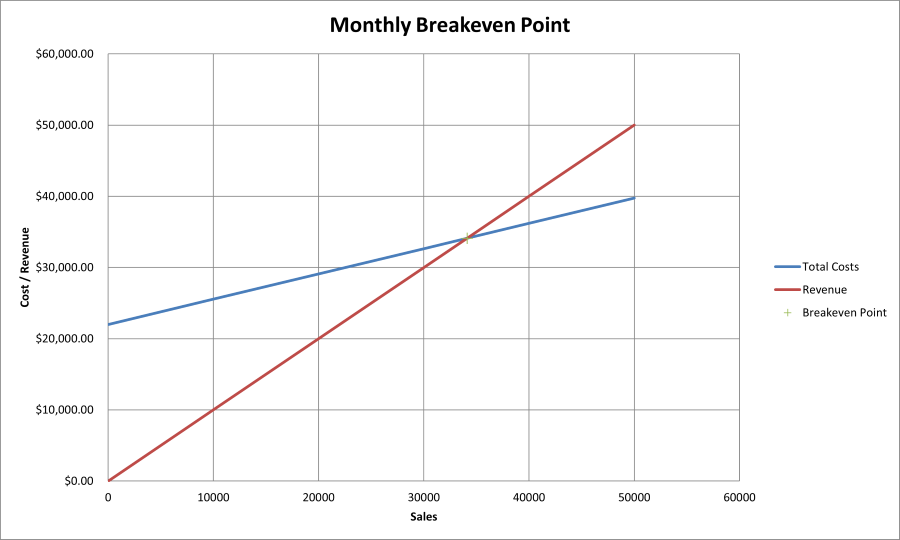
Total monthly fixed costs = $22,000
Step 2 — Work Out Your Average Contribution Margin (%)
Let’s calculate your blended margin.
Example café menu mix:
| Category | Margin | % of Sales | Weighted Contribution |
|---|---|---|---|
| Coffee | 70% | 60% | 0.70 × 0.60 = 0.42 |
| Food | 55% | 30% | 0.55 × 0.30 = 0.165 |
| Drinks (smoothies/juices) | 60% | 10% | 0.60 × 0.10 = 0.06 |
Add the contributions:
0.42 + 0.165 + 0.06 = 0.645 or 64.5%
Step 3 — Plug Numbers into the Breakeven Formula
Breakeven = Fixed Costs ÷ Margin %
= $22,000 ÷ 0.645
= $34,108 per month
This means:
-
Weekly breakeven: $34,108 ÷ 4.33 (weeks per month) = $7,878
-
Daily breakeven: $34,108 ÷ 30 (days per month) = $1,137
If your daily café sales are below $1,137, you’re losing money.
If they’re above — you’re profitable.
See how simple that is?
5. How Many Coffees Do You Need to Sell to Break Even?
This section always gets the most attention.
Let’s break it down.
Example:
-
Average coffee sell price: $5.50
-
COGS per cup (beans, milk, cup): $1.60
-
Profit per cup: $3.90
Your café’s fixed costs: $22,000
Breakeven in cups = 22,000 ÷ 3.90 = 5,641 coffees per month
Which equals:
-
188 coffees per day
-
Or 94 customers if half order coffee + food
This helps you sanity-check whether your café model works.
If you can only serve 120 customers on a normal day but your breakeven needs 180+?
Something must change — pricing, wages, menu mix, or overheads.
6. What Your Breakeven Number Actually Tells You
Knowing your breakeven helps you make smarter decisions instantly. It is your cafe profitability formula.
6 Things Your Breakeven Point Reveals:
-
Whether your menu prices are too low
If your breakeven is sky-high, pricing may need adjustment. -
Whether labour is being overspent
Overscheduling = higher wage % = higher breakeven. -
Whether your café has too many low-margin items
Smoothies and food often look profitable but aren’t. -
If you’re open too many hours
Early mornings or late nights might be costing more than they earn. -
If you can afford new equipment
Will it push breakeven up or help reduce costs? -
When it’s time to increase prices
Supplier increases should always trigger a margin check.
7. How to Lower Your Breakeven Point (Quick Wins)
Even better than calculating breakeven is lowering it.
Here’s how to reduce it fast.
1. Improve Contribution Margin (Your #1 lever)
Ways to increase margin:
-
Switch to lower-cost alternatives (beans, milk, packaging)
-
Add high-margin items (cold brew, batch brew, black coffee promotions)
-
Run specials on items with the highest profitability
-
Use recipe costing sheets to eliminate ingredient waste
2. Reduce Fixed Costs Where Possible
-
Negotiate merchant fees
-
Review electricity plans
-
Remove duplicate software subscriptions
-
Reassess operating hours for slow periods
-
Renegotiate rent or seek rent relief when needed
3. Control Labour Spend
Aim for 28–32% of sales.
Use smart rostering:
-
Base staff numbers on historical hourly sales
-
Reduce prep time where possible
-
Crosstrain staff
4. Optimise Menu Design
High-margin items should be:
-
Easier to spot
-
Highlighted on menus
-
Suggested verbally by staff
-
Bundled into upsell combos
8. When Should You Recalculate Your Café’s Breakeven Point?
You should recalculate when any major cost changes — which in hospitality is often!
Review your breakeven when:
-
Supplier prices increase
-
Ingredient substitutions occur
-
You add or remove menu items
-
Wages or award rates increase
-
Rent increases
-
You open or adjust trading hours
-
You change your menu mix
-
You purchase new equipment or take on new loans
Successful café owners recalculate the analysis every 3 months or whenever a major change occurs. Get to know this hospitality breakeven equation.
9. Free Download: Café Breakeven Calculator
To make this even easier, I’ve created a simple breakeven calculator for you.
It includes:
-
Spaces for your fixed costs
-
Automatic contribution margin calculator
-
Monthly, weekly, and daily breakeven
-
Colour-coded indicators
-
A sample café pre-filled for guidance
10. Final Thoughts: Clarity Creates Confidence
Most café owners underestimate how powerful this one calculation can be. Once you know your breakeven point for your coffee shop, suddenly:
-
You price more confidently
-
You roster more sensibly
-
You understand your menu better
-
You feel in control of your numbers
-
You stop guessing — and start growing
This is one of the simplest, highest-impact tools in your café toolkit.
Follow Along with the Same Example Numbers
The calculator comes pre-filled with the numbers used in this article, so you can follow along without confusion.
Your breakeven results will match the examples line-by-line.
After that, simply replace the numbers with your own café data.
Conclusion
By now, you’ve learned exactly what the breakeven point is, how to calculate it using a simple formula, and why it’s one of the most powerful numbers in your café. If you take action and calculate your breakeven properly, you’ll gain immediate clarity around your costs, pricing, staffing, and daily sales targets. This isn’t just theory — knowing your breakeven gives you control, confidence, and the ability to make smarter, more profitable decisions every single day. Run the numbers, use the calculator, and you’ll instantly see where your café stands and what steps you need to take next to build a stronger, more sustainable business.