Effective Recipe Costings – Project an “Accurate Food Cost”
The whole concept of a recipe is to determine the many factors that would contribute toward a menu item being sold in your establishment.
A Recipe Card Is Like a Road Map in Your Business.
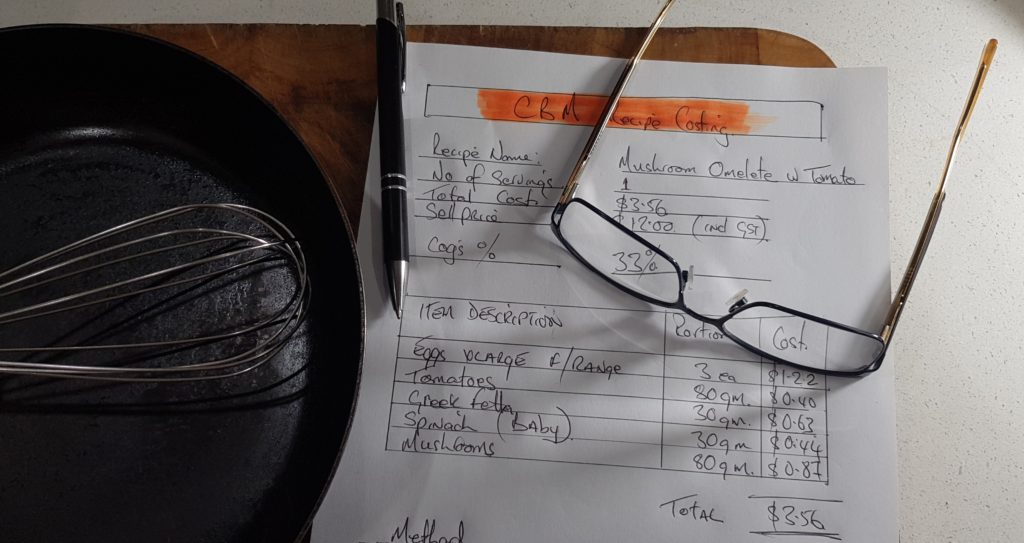
It can provide you the ingredient percentages in your dish, and how many servings you can expect. It will give a batch cost and an individual serve cost, but ultimately a “Food Cost”.
If your staff are trained, and educated in food costs, and following recipe instructions and quantities, then you are well on your way to a profitable business.
However, this is an area that is often overlooked, or given a halfhearted effort, or at best an estimate, as it appears to be a tedious job to be involved in.
The #1 Area You Need To Understand, To Make Any “PROFIT”
As you, the owner, you need to be aware, and know exactly how much every menu item costs to produce, and the profit you derive from selling it.
If not documented accurately it is open to guesstimate quantities, with the net result being a food cost blowout. This is a tremendous costly mistake.
Your profits are being slowly eroded without your knowledge, which is even more of a concern.
Imagine the thought of getting a new menu idea and doing a rough cost on a scrap piece of paper, and then not reviewing it for 5 months.
During that time, a couple of your recipe items incurred price creep, and now your recipe has increased cost of goods, from 39% to 54.9% on a $10.00 menu item. That’s a loss of $1.43 profit on every sale of that item. If you sold an average of 10 per day, and traded 6 days a week, that is an annual profit loss of $4461.60 on just one menu item, and you weren’t even aware. If those couple of product items that incurred price creep, featured on some of your other menu items, then you profit loss would be considerably larger. Quite often, and particularly during peak service times, or even the pressure to reach a deadline for catering, there may be instances where near enough is good enough. This again is losing profits.
What Is Involved
I know you are a smarter manager than the above example, and you want to learn more, about the valuable information provided by your recipe costings. Even better, I can help you to create a recipe form that is simple to use, and manage. (It is the purpose of this blog to not overcomplicate things here).
So, let us understand why…
Why Invest The Time
This process only needs to done once, both accurately and correctly. Reviewed and tweaked at regular intervals along the way. This would then become part of your total sales mix, which is the total food cost for the day, divided into the net revenue amount (excluding tax). So that’s an overall “Cost of Goods” percentage for the day. Now we are getting a bit deeper here, into “Menu Engineering”, and how it can be improved. I will cover this in another post.
What Concealed Information Does a Recipe Provide
A recipe can determine what your cost of goods percentage is. You can enter in seasonal pricing, to gauge the impact of your food cost with price increases or decreases. Best of all based on sales and stock requirements you can determine if it stays or goes. Did I mention that you can compare a menu item with your competitors and decide if you want to alter, change, or improve to remain competitively, profitable. All these decisions can be made easily, by reviewing your recipes and sales mix, and altering specific areas to either maintain or improve your profits.
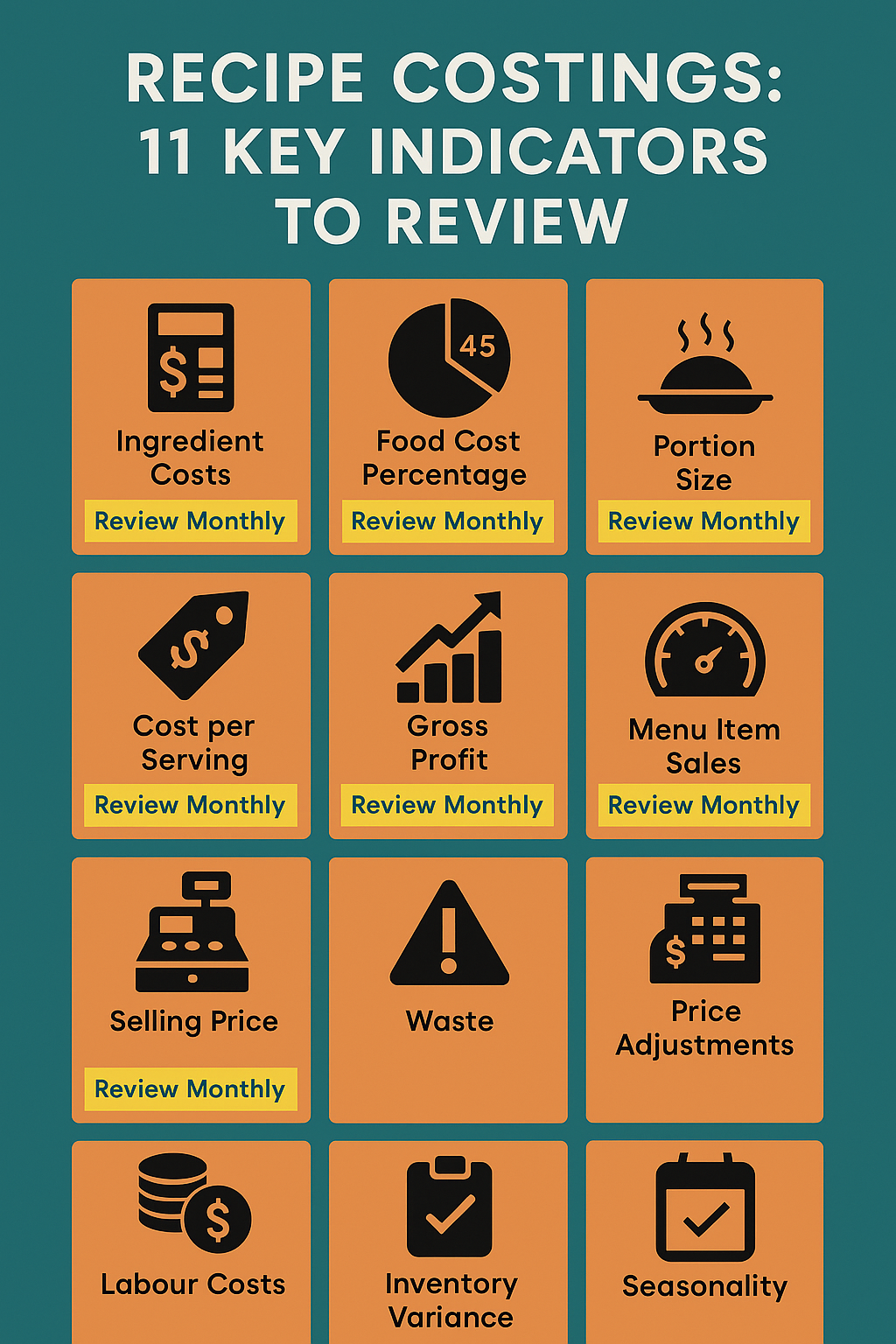
11 Key Indicators You Need From Your “Recipe Cards”
- Ingredients: These are listed along with the amounts of each ingredient required. Try to list in the order they are used as per the method, then nothing is missed.
- Ingredient Cost: A calculation based on the actual item purchase price (kilo), divided into a measure (grams), multiplied by the amount used (grams). $2.90 ÷ 1,000 x 75 = $0.22
- Method: Provides the directions of how to prepare. Try to number the steps so it is easy to follow.
- Equipment: Not all recipes have this. However, if you are baking, it is good to specify tray size, or mould type.
- Number of servings: How many portions your recipe creates. This is particularly important in batch recipes, like salads, platters, slices, quiches etc.
- Yield: This is the total weight of your finished dish.
- Serve Size: This is an individual serve size. Yield ÷ servings
- COG %: Your “Cost of Goods” percentage, is perhaps the most single important piece, of information you require from this document. This is your profitability target.
- Ingredient Costs: The total sum cost, of all items and quantities used, provided as a separate Batch and Serve cost
- Retail Price: A proposed retail price for this menu item. Changing this will affect your COG% (8). It will also let you know how you compare to your competitors pricing
- Ingredient %: “I love this one”. It is intelligence at its best. It shows the most each product contributes to the cost of the menu item. You can add more of this and less of that, to alter your COG’s. An area of refinement and tuning.
Does this sound like a powerful tool for you to have knowledge of? You betcha.
There are a few other things that I haven’t added like;
- Nutritional Analysis
- Photos
- Menu Category
These Are The 4 Things “You NEED To Review Monthly”
- Product Purchased: This is the same product listed on the recipe card that is purchased in
- Ingredient Cost: Confirm the pricing has not changed on any menu item that has a 10% or greater Ingredient %
- Yield Serve Size: That the actual portion size is the same as what’s being dished. If you get 8 serves from a batch and your recipe card is costed for 12 serves, then you are giving money away.
- Ingredient %: Concentrate only on the items that have the highest percentage, as this will have the greatest impact on your COG%. Don’t sweat the small stuff.
In Summary
I would sooner evaluate and manage my recipes each month than throw hard earned money away as a discount. You could be losing money on each served menu item, simply due to staff guesstimating. Knowledge of your exact food costings for every sales item you sell is really powerful stuff. Documented, Collated, and Reviewed monthly, you can answer a lot of questions, and make a lot of decisions simply from your “Recipe card”. Another spin off is that knowing this will assist in helping you remain competitive. It could open new revenue streams to wholesaling, targeting other businesses, or even starting to establish off site catering, and takeaway Uber eats. Do you want to steer your business toward more market share, more profitability, more growth, and better planning?
How Can I Start?
If you have already created a “Recipe Card System” in excel, or have a subscription to an online service then congratulations you are well on your way. All you need to do now is review and monitor your recipes with those 4 key points above. If you have scrap paper recipes, possess a little knowledge of Excel, and want to take the advantage to getting a bit more serious about your business, then you are in the right place.
One Change, Thousands in Profit: Why Recipe Reviews Matter
Remember the scenario above where we discussed price creep? The same principle works in reverse—particularly when you regularly review your recipe items.
Say a rep drops by and offers you a product that’s slightly cheaper than your current ingredient—but without sacrificing taste or quality. Let’s say it’s a key ingredient that makes up 28% of a recipe’s cost.
By switching it out, your cost of goods drops from 39% to 30.5% for the same $10.00 menu item. That’s an 8.5% saving, which puts an extra $0.79 in profit back in your pocket per sale.
Now do the maths: based on the sales volume we talked about earlier, that’s $2,464.80 extra profit per year—from just one menu item. For some cafés, that’s a month’s rent, or even more.
And imagine if that same ingredient appears across multiple dishes…
I hope you found this helpful. Got something to add? Did I miss anything? Want to go deeper on this? Drop me a comment—I’d love to hear your take.